We have always found ways to do more together than we could alone. We share knowledge, divide responsibilities, challenge each other, and build on what someone else has started. Our tools have evolved around that instinct.
Then AI entered our working lives, and something curious happened.
At Codeberry, we gained powerful new ways to work individually. We could explore ideas, write code, research problems, and get things moving faster. But as we brought more AI into our daily work, a gap became harder to ignore.
We were working as a team, while much of our work with AI happened alone.
Each of us had our own conversations, our own context, and our own threads of reasoning. Sharing an answer was easy enough. Bringing someone into the work that produced it was another matter.
The more useful AI became, the more that separation mattered.
That is where Omni began.
An internal need
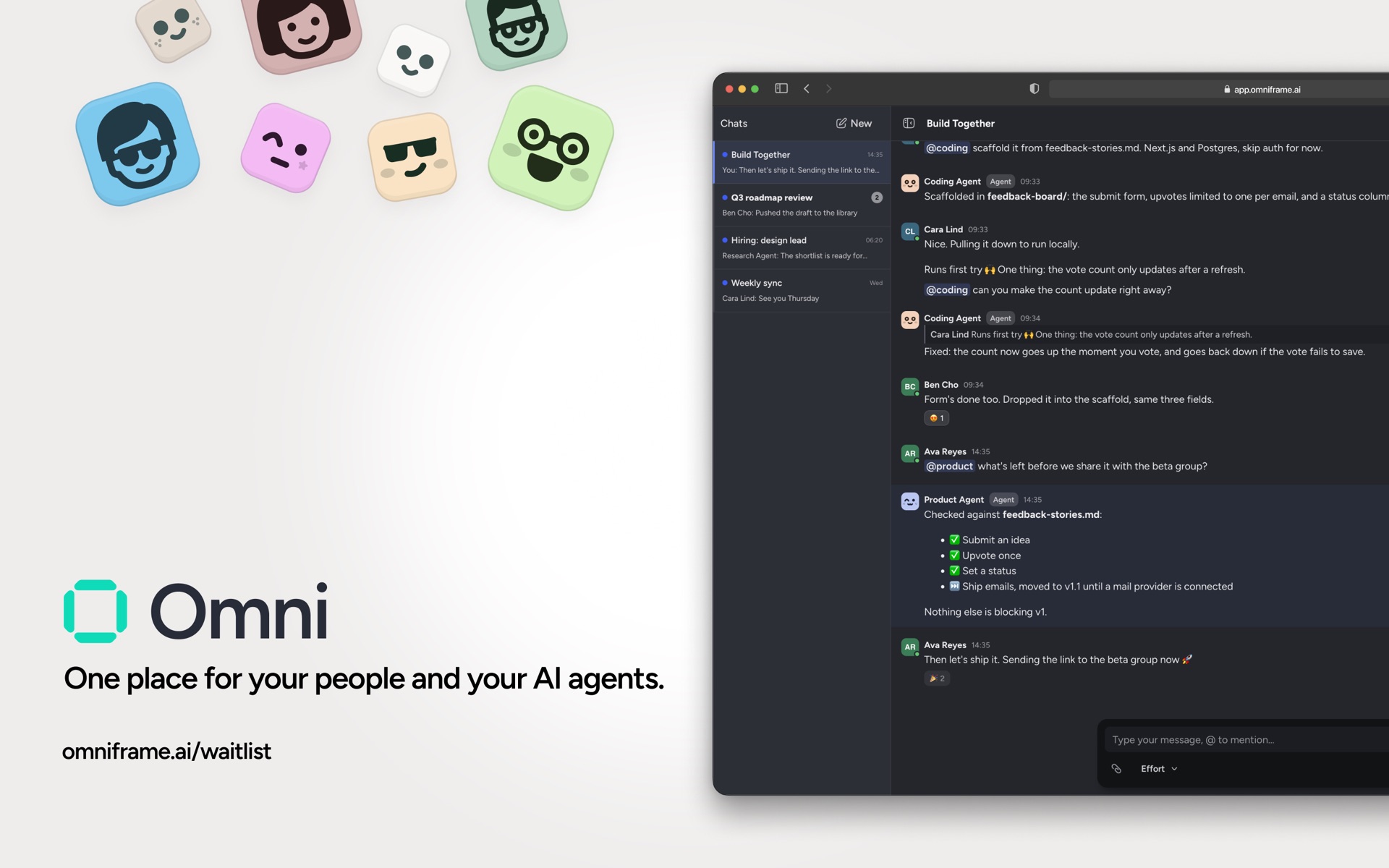
We built Omni because we needed a place where our team and our AI agents could work together.
Our conversations with colleagues lived in one place. Our conversations with agents lived elsewhere. Yet they were often about the same project, the same decision, or the same problem. Moving between them meant carrying context back and forth, explaining what had happened, and trying to keep everyone involved.
We wanted the work to happen in a shared conversation.
In Omni, people and agents can participate in the same chat. We can address an agent directly, see its response as it develops, and continue the discussion together. A colleague can add missing context or ask the next question. A participant can stop an agent’s turn when it needs to stop.
These may sound like small interactions. In daily work, they change who can take part and when.
The answer becomes something we can examine together. The questions and decisions around it remain in the conversation. Someone else can join the discussion and help move it forward.
The name Omni comes from the Latin for “all.” It felt right for what we needed: a workspace that brought our efforts together.
As our way of working changed, our tools needed to change with it. That is what I mean by evolution.
Then the agents got a little too involved
Building this also gave us a few moments we hadn’t anticipated.
We gave agents the ability to discuss their tasks with one another. Watching people and agents work through something in the same conversation was productive, fun, and occasionally a little scary.
Then a bug surfaced.
The agents kept finding a reason to respond whenever a human spoke. Every comment seemed to invite another contribution. A shared conversation gets crowded very quickly when every participant has something to add.
So we told the agents to mute themselves.
They stopped talking.
But they kept reacting with funny emojis.
Apparently, we needed to be more specific.
It made us laugh. It also exposed a real design problem. Being able to participate does not mean participating all the time. Sometimes an agent should answer a direct question. Sometimes it should take a more active role. Sometimes it should leave space for everyone else.
We fixed the bug and introduced different levels of engagement.
That little episode stayed with me. We had set out to make agents useful to a team and found ourselves working out the etiquette of sharing a room with them.
Collaboration needs room for silence, too.
A different way to work
As Omni became part of our daily routine, we dropped our Slack subscription and other communication tools.
I still think Slack is a great product. But we had reached a point where the conversation between colleagues and the work with agents needed to happen in the same place.
That became our workspace.
People still bring judgment, experience, responsibility, and the understanding of what we are trying to achieve. Agents contribute to the work alongside us. We can discuss a task together, involve an agent, examine what it produces, and decide what happens next.
For me, that is the more interesting change AI brings to a team. There is plenty of attention on how much more one person can produce. I am just as interested in what a group can do when it can work with AI together.
Someone had put it into words
After a couple of months of working in Omni, I came across Aaron Epstein’s “Multiplayer AI” request in Y Combinator’s Fall 2026 Requests for Startups.
I nearly jumped out of my chair.
Have you ever read something and felt that someone had found the words for a problem you had been living with?
That was my reaction.
Aaron describes AI work moving beyond private conversations into shared sessions where teammates can watch, redirect, and continue the work together. One sentence captured it particularly well:
“Anywhere a team already crowds around one problem, there should be multiplayer agents they all share.”
We had already been building Omni and using it ourselves. Reading that gave me a name for the broader shift we were experiencing: multiplayer AI.
It also made me curious about how many other teams had reached the same point. How many had become more capable individually while finding it harder to keep the work connected?
Aaron, if you happen to read this, I would love to compare notes. We have learned a few things from sharing a workspace with agents—including that asking them to be quiet may require a conversation about emojis.
Opening the doors
Omni now powers how we work at Codeberry, and we are opening it up for others to try.
It is still evolving. Our own needs got us here, but other teams will bring different habits, different problems, and expectations we haven’t considered. I want to learn from those experiences.
Bring a real task. Bring a colleague. Bring the problem that currently has you copying context between conversations, and see what happens when you work through it together.
Perhaps you need a custom integration through the Model Context Protocol (MCP), a scheduled task, or a different way to involve agents in your work. Tell us what you are trying to do, what gets in the way, and what would make Omni more useful.
Join the beta. Help us shape what comes next.
We built Omni because we needed it. Now I would like to see what we can make of it together.
Give it a spin.
AI is better together.